
Columbia County Projected Versus Actual Release
A projected release date is an estimate based on the sentence information and credits held by the responsible agency when the record is checked. Oregon Department of Corrections and VISOR use the label “projected release date,” often shortened to PRD. Preserve that exact label and record the day the result was viewed. Calling it an actual release date changes its meaning.
An actual release record documents what happened. It should identify when physical custody ended, the legal basis, and whether the person entered the community or another custodian's control. A projected date can arrive and pass without community release because a detainer, court order, transfer, or recalculation changes the outcome. Conversely, eligible transitional leave can move someone out of physical prison custody before the full incarceration endpoint.
Pretrial detention works differently. A person awaiting Columbia County court action often has no sentence-based date. Bail, recognizance, conditional release, dismissal, plea, trial, sentencing, and holds can control the next step. The jail roster's scheduled release field may also be blank, and a filled value remains prospective.
Find Columbia County Projected Release
Classify custody before searching. A Columbia County Jail stay belongs to CCSO and the court. An Oregon prison term belongs to ODOC. A local roster should not be used as a state-prison locator, and Oregon Offender Search is not an archive of every local booking. The judgment supplies the sentence structure; the custodian applies the information it is responsible for administering.
- Check the current Columbia County roster and save its timestamp, name, book date, and any booking or file number.
- Read the final Columbia County Circuit Court judgment for sentence length, consecutive or concurrent structure, and jail credit.
- For an ODOC term, search Oregon Offender Search by full name and repeat with the SID when available.
- Copy the exact status, location, and projected or earliest release label, plus the date checked.
- Compare VISOR and ask the responsible records office for official clarification when dates conflict.
The broader Columbia County released inmate search helps identify the custodian before a date lookup. If the judgment commits the person to ODOC, disappearance from the county roster is expected during transfer and is not evidence that the person entered the community.
ODOC Columbia County Release Date Search
Oregon Offender Search accepts a name or Oregon State Identification number. A result may show a photograph, public identifying information, DOC status or location, and a release-related date when one applies. A SID is more stable than a name and helps separate similar records. Compare the photograph and public identifiers cautiously.
| OOS item | How to read it |
|---|---|
| Name or SID | Search key and identity check |
| Photograph and identifiers | Comparison aids, not sole identity proof |
| Status | Current DOC custody or community-corrections context |
| Location | Prison, community placement, or another recorded DOC relationship |
| Projected or earliest date | A forecast that must retain the system's exact label |
ODOC says OOS is updated periodically, may change, and is not an official record. A community location, parole, or post-prison supervision may confirm release from a prison bed while also showing that discharge has not occurred. A prison location means community release has not happened. A county-jail or institution-based entry can reflect temporary placement or a detainer.
The Oregon Offender Search entry displays the search and disclaimer.
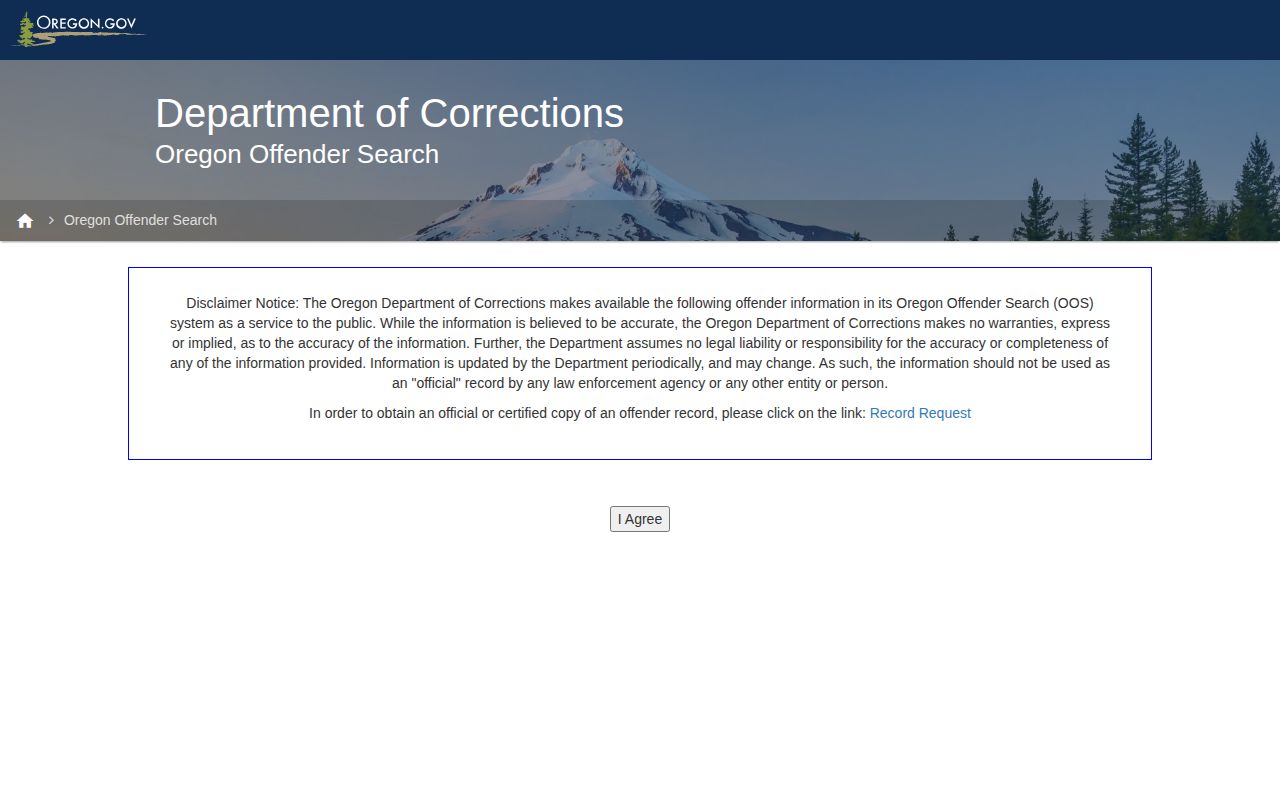
The official application is the state starting point, but a face sheet or discharge record is stronger proof when the date matters formally.
Columbia County Release Earned-Time Factors
For eligible adults sentenced to DOC custody for felonies committed on or after November 1, 1989, ORS 421.121 permits earned-time reductions for appropriate institutional behavior and participation in the adult basic-skills program. The maximum under that statute may not exceed 20 percent of the total DOC incarceration term. Credits cannot shorten actual prison confinement below six months.
The statute is not an automatic calculator. DOC rules govern granting, retracting, and restoring credits. Eligibility matters, and ORS 421.121 expressly excepts sentences governed by ORS 137.635, 137.700, 137.707, 163.105, 163.107, and 163.115. A person should not subtract 20 percent from a judgment and publish the result as a Columbia County release date.
County jail credit and DOC earned time are also different concepts. Jail credit accounts for qualifying time already spent in custody as the judgment and law direct. Earned time is a possible reduction within the DOC framework. Consecutive sentences, which run one after another, differ from concurrent sentences, which overlap. The judgment must be read before any forecast can be understood.
The ORS chapter 421 earned-time provisions provide the controlling statutory text.
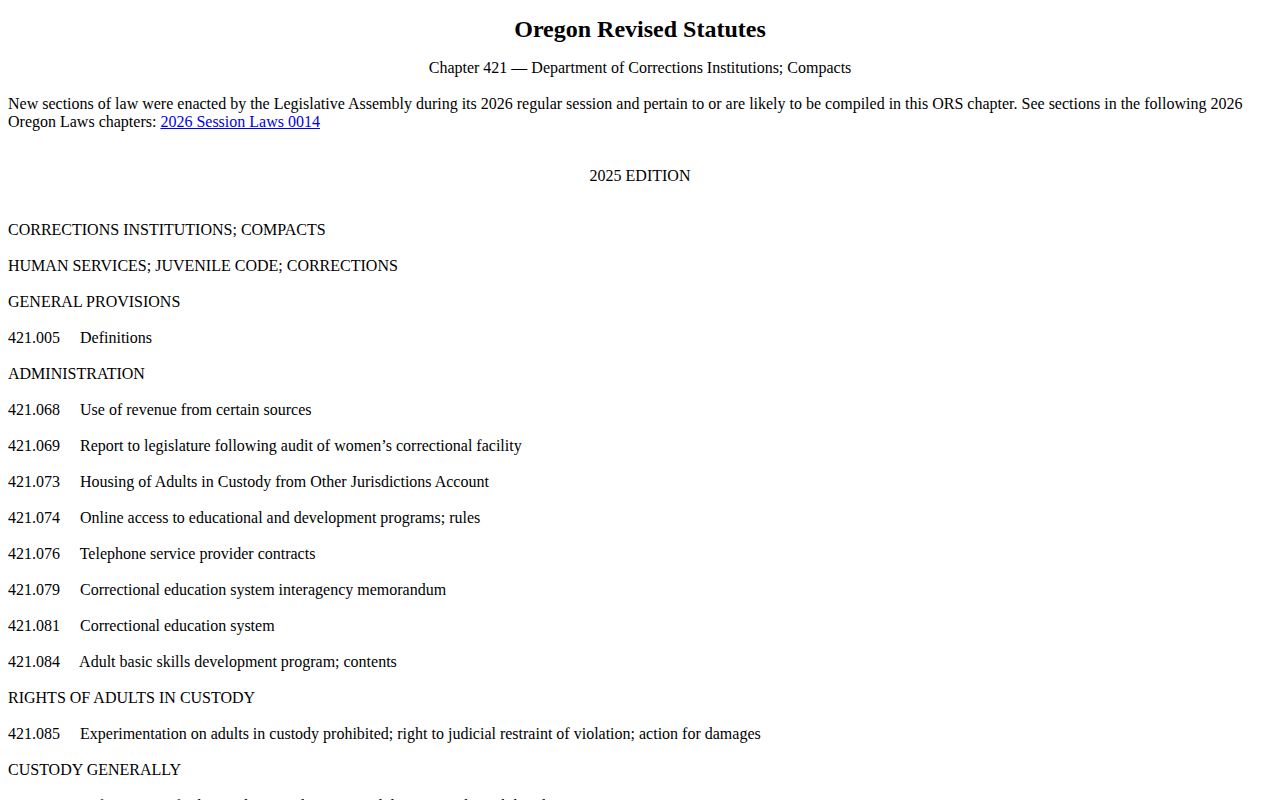
The statute shows why a percentage ceiling is only one input in ODOC's sentence computation.
Oregon Has No 85-Percent Formula
Oregon's rules make a generic “serve 85 percent” claim inaccurate. This is the distinctive computation issue for a Columbia County projected release date. Eligible DOC terms under ORS 421.121 may receive no more than a 20-percent earned-time reduction. Offense-specific mandatory minimums under ORS 137.700, often associated with Measure 11, ordinarily cannot be shortened through earned time, temporary leave, work release, or program participation during the mandatory term.
ORS 137.712 provides limited exceptions for certain convictions when required findings are made. It does not create a general discount. The exact conviction statute, offense date, judgment, and later orders control. Some sentences under ORS chapter 163 also follow distinct minimum and review rules. A national percentage rule cannot replace those Oregon sources.
The practical result is straightforward. Do not calculate a Columbia County prison release from the sentence length alone. Copy the ODOC PRD, compare it with the judgment, and ask Sentence Computation or DOC Public Records when they conflict. Good conduct can affect an eligible credit decision, but it does not erase an ineligible mandatory minimum.
Why Columbia County Release Dates Change
A projected date can move because the legal or administrative inputs change. VISOR currently warns that an Oregon Supreme Court opinion changed calculation of some prison sentences and that registered users will be notified if a PRD changes. That notice reinforces the need to record the retrieval date and check again near the expected event.
| Factor | Possible effect | Best source |
|---|---|---|
| Earned-time grant, loss, or restoration | Moves an eligible forecast earlier or later | ODOC sentence record |
| Jail credit correction | Changes time credited toward the term | Judgment and computation record |
| Resentencing or amended order | Changes the controlling sentence | Court judgment |
| Consecutive sentence or revocation time | Adds custody that may not appear in a simple first estimate | Court and DOC records |
| Detainer | May cause transfer instead of community release | Custodian and issuing jurisdiction |
| Transitional leave | May end physical prison custody before the full incarceration endpoint | ODOC status and release record |
A detainer is a request or legal basis for another authority to take or retain custody. It can make “released from DOC” mean transfer to another jurisdiction. Short-Term Transitional Leave is a structured release from physical prison custody for eligible people under statutory and rule criteria. Neither should be reduced to the word “free.”
Confirm Columbia County Actual Release
Near the PRD, recheck OOS and VISOR. A VISOR alert can report a release, transfer, or supervision change, but the service is updated periodically and is not an official record. Treat the message as a prompt. For a pending status notification, follow the current Oregon VISOR inmate check process. Oregon replaced its former VINE service in 2023, so current registration does not use an old generic VINE PIN workflow.
For county jail custody, use the county records process to ask CCSO for the actual release or transfer record. For a prison term, request the public face sheet or relevant discharge material from the ODOC Public Records Center. DOC describes a public-information Pen Pack as potentially including first and last face sheets, public information prints, a photograph, judgments, and some parole discharge or violation material.
Compare the event record with the final judgment. A dismissed charge, sentence completion entry, or past PRD can coexist with another hold or case. The strongest confirmation pairs custodian proof with the court record and, when applicable, the supervising office. Note: A release from a prison bed may begin parole or post-prison supervision rather than end correctional authority.