
Columbia County Release Meanings
A person who leaves Columbia County Jail has left one displayed jail population. That fact does not always mean unrestricted return to the community. The Columbia County Sheriff's Office may release someone after security is posted, on recognizance or conditions, after a sentence is served, or under a court order. It may instead transfer the person to the Oregon Department of Corrections, another county, or federal custody. A court-authorized book-and-release is another local event. It records the booking process and then returns the authorized person to the community, often while the case continues.
The record custodian changes with the event. CCSO holds the county booking and release or transfer record. A court holds the judgment and case entries. Oregon DOC holds state-prison and discharge material. Columbia County Community Justice may hold a supervision relationship after parole, post-prison supervision, or probation begins. The agency that arrested the person is not necessarily the agency that ended custody.
- Release
- Physical departure from a particular jail or prison, either to the community or another legal status.
- Discharge
- Completion of a sentence or supervision obligation, which is broader than walking out of a facility.
- Detainer
- A request or legal basis for another agency to take custody when the present custody ends.
- Time served
- A sentence credited as already completed through time spent in custody.
Columbia County Release Types
Release language should be preserved exactly. “Released,” “transferred,” and “discharged” do not describe the same outcome. Charges can remain pending after a pretrial release. A local sentence can end while probation begins. A state-prison term can end in parole or post-prison supervision. Another hold can move a person directly to a new custodian.
| Event | What it means | Best next source |
|---|---|---|
| Security, recognizance, or conditional release | The person leaves jail while the case may continue under court terms. | CCSO release record and court register |
| Time or sentence served | The local custody term ends, but supervision or another case may remain. | Release sheet and final judgment |
| Parole or post-prison supervision | Physical prison custody ends while correctional supervision continues. | OOS, VISOR, and Community Justice |
| DOC or outside transfer | The person changes custodians and is not released to the community. | Receiving locator and transfer record |
| Book-and-release | An authorized person completes identification, photo, and fingerprint processing, then leaves. | CCSO booking and court paperwork |
The CCSO Bookings & Releases page describes a special Monday processing appointment, not a list of people recently released. CCSO says an authorized officer, deputy, or court must approve it. The person brings the court papers, government identification, and Book and Release Form. Calling that page a release feed would give the wrong answer.
The official book-and-release page is visible in this captured source:
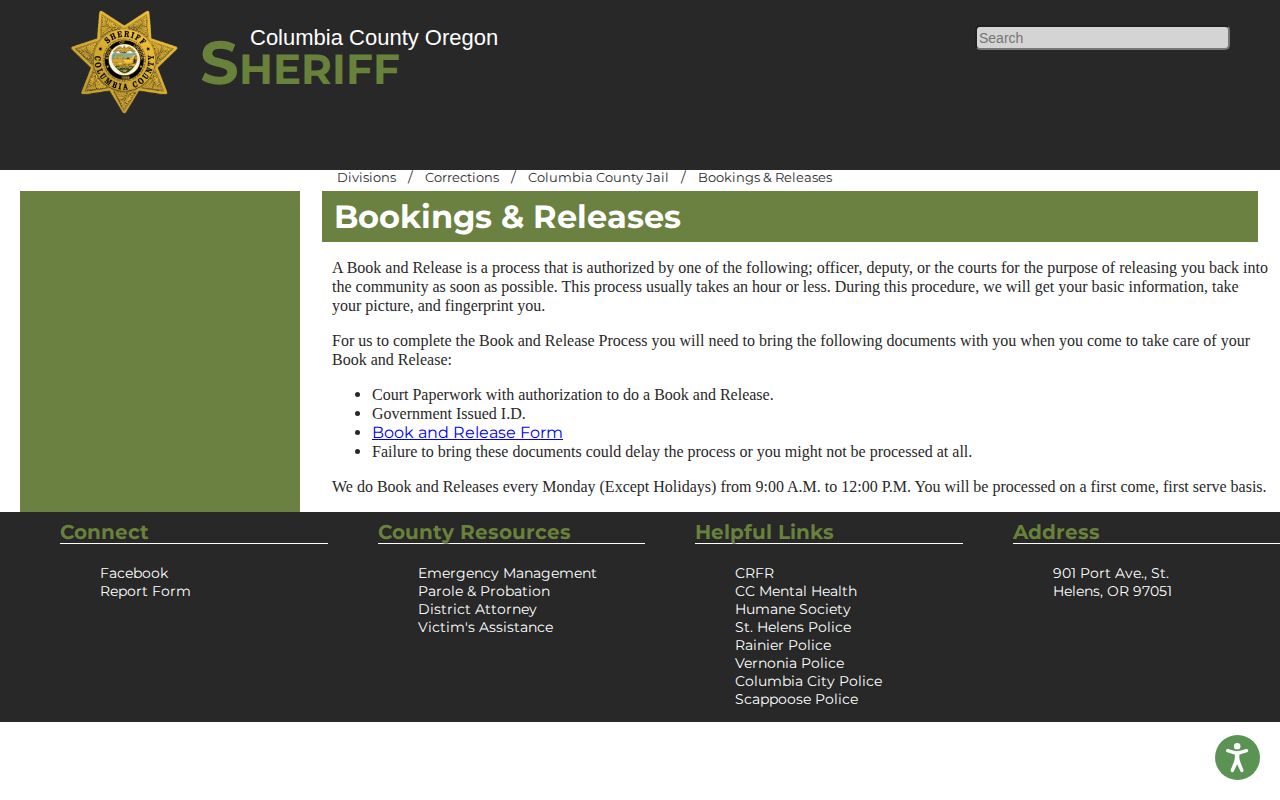
Its procedural focus helps separate an arranged booking event from a historical Columbia County release record.
Columbia County Release Record Fields
A complete Columbia County release record should answer when custody ended, why it ended, and where the person went. The live roster does not provide those facts after departure. Its scheduled release date is prospective and can be blank. A request is stronger when it names the person, date range, booking number, or file number and asks for the exact maintained fields.
| Field | What it establishes |
|---|---|
| Actual release date and time | When the Columbia County jail event ended, rather than when it was expected to end. |
| Release type or coded reason | Whether the event involved security, a court order, time served, transfer, or another authority. |
| Destination or receiving agency | Whether the person entered the community or another custodian's control. |
| Booking and file numbers | Stable links to the correct jail stay and related records. |
| Charges, disposition, and sentence | Context for the release, subject to comparison with the final court judgment. |
| Photograph | An identity aid that is subject to Oregon's separate booking-photo restrictions. |
Request Columbia County Release Records
Use the Columbia County Records Policy and request form for the formal path. The county routes a request to the custodian, estimates cost, and may require prepayment. Routine paper copies are listed at $0.25 per page. That amount is not a guaranteed flat price for a release packet or photo. Specialized work, redaction, media, and legal review may cost more.
- Identify the person and the approximate confinement dates. Add the booking or file number when known.
- Ask CCSO for the booking and release record, actual date and time, coded authority, and any receiving agency or destination maintained.
- Request electronic delivery and a cost estimate before work exceeds a stated limit. Ask for the booking photo separately if release is authorized by law.
- Track the response. Oregon law generally requires acknowledgment or completion within five business days, then completion or a processing estimate under the later statutory timetable and exceptions.
- Compare the returned record with the court judgment, VISOR, OOS, or the receiving system when the packet identifies another custodian.
901 Port Avenue
St. Helens, OR 97051
Phone: 503-366-4611
Fax: 503-366-4644
Monday-Friday, 8:30 a.m.-5:00 p.m.; Sunday, 8:30 a.m.-4:30 p.m., closed noon-12:30 p.m.; Saturday and major holidays closed
Keep the request narrow. The sheriff cannot certify an Oregon prison discharge or a federal release it did not control. Likewise, a court clerk can supply a judgment but not necessarily the actual minute the jail opened the door.
Columbia County Release Retention
Oregon Public Records Law, including ORS 192.311 through 192.478, governs access to nonexempt public records. ORS 192.324 establishes the initial acknowledgment framework and permits actual-cost fees. Exempt or protected content can be withheld or redacted, including juvenile, victim, medical, security, and active-investigation information. A public booking field does not make every item in a jail file open.
Online visibility is much shorter than agency retention. Oregon's county records schedule treats local booking records as documents of confinement and release. It sets minimum periods of 20 years for homicide records, 10 years for felony records, and 5 years for misdemeanor records. Booking video is a different series with a 30-day minimum. Those periods support a later formal request, but they do not promise that every image or database field survives for the whole term.
Adult set-asides proceed through the court of conviction under ORS 137.225. Certain drug-enforcement misdemeanor records have targeted sealing rules under ORS 137.224. A sealed or set-aside case may disappear from ordinary public results, so “no result” is not proof that no record ever existed.
Note: Always name the precise record type because a still photograph, booking log, and booking video can follow different access and retention rules.
Columbia County Court Release Records
Columbia County has more than one court custodian. Circuit Court handles state criminal cases, while a city ordinance matter may belong to a municipal court. Neither court is the jail custodian. The charging court's register and final judgment can explain dismissal, security release, credit for time served, probation, or commitment to DOC. The CCSO release record remains the source for the physical county-jail event.
OJCIN OnLine covers registers and judgments from Oregon circuit courts as a paid subscription service. Free eCourt terminals and clerk-counter access are official alternatives. Search the correct Columbia County case and compare a common-name match with the case number and lawful identifying details. A dismissal may resolve a charge while another hold remains. A DOC commitment often explains why someone vanished from the local roster without entering the community.
The court's access options are shown on the official OJCIN source:
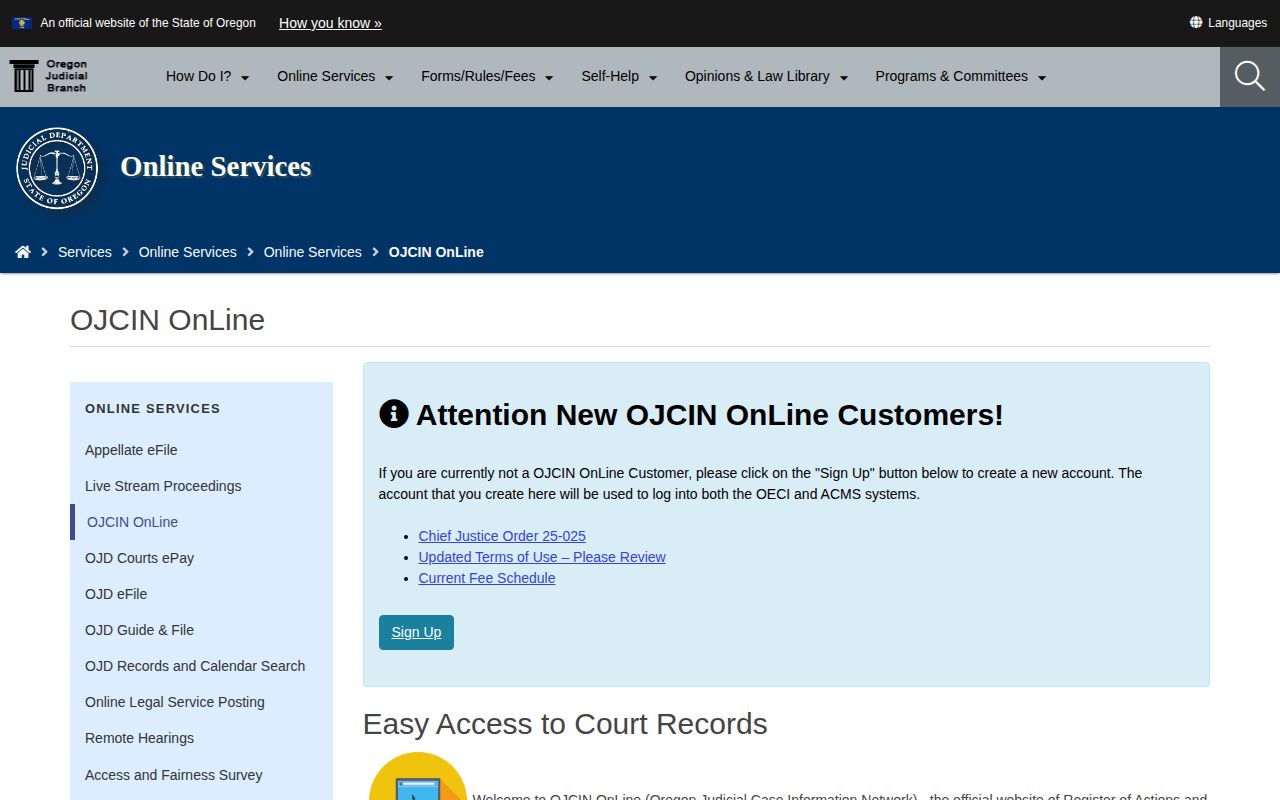
That court record should be paired with the custodian's release or transfer entry when the physical departure matters.
Columbia County Expunction Records
Juvenile expunction follows a separate local path. The Columbia County Juvenile Department describes expunction as destruction or permanent sealing so the covered records are no longer public. Questions go to the Juvenile Department at 503-397-0275 in the Historic Courthouse. Adult and juvenile procedures should not be merged.
Oregon also limits booking-photo release under ORS 133.870. A sheriff may release a photo through listed pathways, but the text release record can be available even when a photograph is not. ORS 133.875 creates removal duties for publish-for-pay publications. A documented acquittal, nonprosecution, set-aside, vacatur, or pardon can trigger a seven-calendar-day removal rule without a fee. That rule does not turn a commercial image page into reliable proof of custody or release.
Find Columbia County Released Inmates
Start with custody classification, not a broad name search. The CCSO Current Inmate Listing can show whether someone remains displayed. Save its generated timestamp and stable booking details. Absence triggers more checks because Columbia County publishes no official historical, 24-hour, or 72-hour release feed.
- Check the timestamped current roster. Treat the scheduled release field as a forecast, not proof of a completed event.
- Call CCSO Corrections at 503-366-4630 or request the actual release or transfer record.
- Search VISOR for a custody or supervision change. Then use OOS if a state-prison sentence or DOC commitment applies.
- Read the charging court's disposition and judgment. Confirm any destination named by the jail record.
- Use BOP, USMS, or ICE only when the case or record supports that federal custodian.
The official roster landing page shows the current-custody scope:
Its limited scope is why a released-person search must continue through records and the appropriate receiving system.
Readers comparing today with a wider period can use the Columbia County 24-Hour Release List explanation, which leads with the official fallback rather than an invented feed.
Oregon Search for Columbia Releases
The Oregon Offender Search is the state-corrections route. It is useful when a person served an Oregon prison sentence or remains under DOC or community-corrections authority after physical release. It is not a county booking archive. Someone who posted security, finished a short Columbia County jail term, or had a case dismissed may never appear there.
| Search or result field | How to use it |
|---|---|
| Name | Begin with the full name, then verify the returned identity carefully. |
| Oregon SID | Use the stable state identifier to reduce similar-name errors. |
| Photo and identifiers | Compare identity without treating the image as proof of current status. |
| Status or location | Distinguish an institution, community placement, supervision, and discharge. |
| Projected release date | Record the exact label and retrieval date; do not convert a forecast into an actual release. |
ODOC warns that OOS is updated periodically and is not an official record. When the result matters, request a public face sheet, sentence material, or discharge document from the DOC Public Records Center. A public “Pen Pack” may contain first and last face sheets, a photograph, judgments, and some parole-discharge or violation material.
Columbia County Recent Release Limits
The direct CCSO feed is a timestamped current roster. It lists name, book date, charge, bail, and a scheduled release date. Linked detail records can include booking and file numbers, arrest and booking dates, physical descriptors, charges, disposition, sentence, and a current booking photograph. Those rotating detail links disappear as the displayed population changes.
CCSO does not state an update cadence or online retention period. Observed timestamps do not support calling it “real time” or guaranteed hourly. There is no actual-release time, completed-release reason, destination, or historical filter. Do not create a recent-release list by comparing saved snapshots. The result could miss transfers, corrections, or short display windows and would not establish legal authority.
Columbia County Release Supervision
The Columbia County Community Justice Adult Division supervises local probation, parole, and post-prison supervision. Probation generally follows a court order and may occur without a prison term. Parole and post-prison supervision follow physical release from prison but do not mean final discharge. OOS or VISOR can supply a first status clue, while the Adult Division can route a purpose-neutral inquiry about local assignment.
Columbia County's program layer is broader than a name lookup. The Adult Division describes specialty-court and Justice Reinvestment Initiative work, treatment referrals, work crews, behavior-change programming, and transitional residence support. Its 20-bed residential program has 12 beds for men and 8 for women who are released from corrections or on supervision. Those services explain how release can move into structured local support rather than end all correctional contact.
The office's own reporting form asks whether the person was just released from jail. That detail links the county jail event to immediate supervision reporting. It should not be used to infer private schedules, addresses, treatment, or case-plan details.
Columbia County Release-Day Documents
State-prison release has a distinct property and document rule. ORS 421.125 requires DOC, on discharge or parole, to ensure that the adult is properly clothed and addresses money and release documents. That duty is different from the Columbia County Jail's local property-return process. It offers a statutory place to start when the question concerns what should accompany an Oregon prison release.
At Columbia County Jail, property release is appointment-only. The person in custody submits a request that identifies the recipient, relationship, and working phone number. Pickup requires valid state identification. A property handoff does not prove that the person has been released, and a DOC discharge duty does not govern a routine county-jail property pickup.
Columbia County Release Notifications
Oregon now uses VISOR, which replaced the former VINE service. VISOR covers Oregon DOC, Oregon Youth Authority, all county jails, Community Corrections, and the Board of Parole. A person may remain searchable after leaving a bed because the result can show supervision. Notifications can cover release, transfer, escape, death, and important supervision changes.
Search by full or partial name, Oregon SID, or county ID. Compare the correct identifier, agency, and status. Registration can use phone, text, email, or TTY, and Oregon's current interface does not document an old-style VINE PIN step. The monitored person is not told who registered. VISOR remains a periodic notification aid, not a certified release record. Call 855-691-6246 for 24-hour assistance when a web result is unclear.
Columbia County Federal Release Transfers
A `USM HOLD` label on the live jail roster supports U.S. Marshals involvement, but it does not prove ICE custody, a BOP sentence, or community release. Someone may leave Columbia County Jail in Marshals custody and remain detained elsewhere. Confirm the jail's transfer authority, then consult the federal docket or the District of Oregon USMS. BOP is relevant only if the person entered BOP custody.
The BOP Inmate Locator may retain a past release date for federal custody from 1982 onward. “Released” or “Not in BOP Custody” establishes only the end of BOP custody. Another justice system or supervised release may follow. “In Transit” and a Community Corrections Management location are not ordinary community-release proof.
ICE ODLS has a different window. ICE says it can include people in custody and some people released within the last 60 days, subject to exclusions and lag. No official source reviewed identified an ICE detention facility in Columbia County. Missing from ODLS is not universal release proof, and a USMS hold should never be converted into an immigration claim without independent support.
Columbia County Release Status Compared
Each public system answers a narrow question. Match the source to the custodian and date. Two-source confirmation is best when identity or destination matters.
| Source | What it can show | What it cannot prove alone |
|---|---|---|
| CCSO current roster | Who is displayed in Columbia County Jail now and scheduled fields | Why an absent person left or where the person went |
| CCSO release record | Actual local release or transfer details maintained by the jail | Later state, federal, or supervision completion |
| OOS | Oregon DOC status, location, identifiers, and a release-related date | Every county booking or a certified event |
| VISOR | Custody and supervision search plus confidential status alerts | An official certified record |
| Court judgment | Disposition, sentence, probation, dismissal, or commitment | The exact time physical custody ended |
| BOP or ICE locator | Custodian-specific federal status within each system's limits | Universal freedom from all custody |
Columbia County Jail Release Route
Columbia County Jail is the only detention facility in the research Facility Map. CCSO operates it at 901 Port Avenue in St. Helens. It holds local pretrial and typical short-sentence cases and also stages some people for transfer. A departure may lead to the community, Oregon DOC, another county, or federal custody. The jail release or transfer record identifies the first step; the court, VISOR, and receiving locator complete the chain.
No official source reviewed identified a state prison, federal prison, municipal jail, or ICE detention center physically inside Columbia County. City court cases can still send people to the county jail, and state or federal custody can begin after a local transfer.